
Why vocational fleets face different road risks than highway trucking
Construction, utility and waste fleets deal with frequent stops, job sites, urban routes and crews who drive but are not professional drivers. Sets up the case for video safety in vocational work.
Share


Why vocational fleets face different road risks than highway trucking
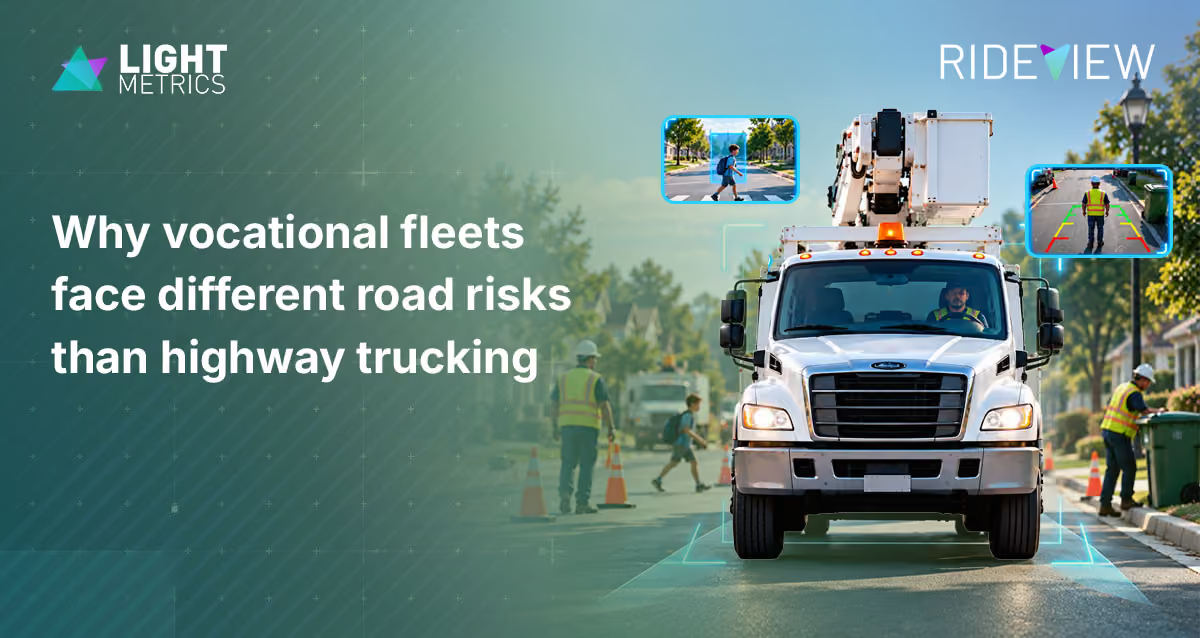
Vocational fleets, the construction, utility, waste, concrete and service trucks built for a job rather than a haul, face road risk that looks nothing like long haul trucking. Their danger lives in frequent stops, low speed maneuvering, residential streets and improvised job sites. Safety programs borrowed from highway fleets miss most of it, which is why vocational fleet safety deserves its own playbook.
The severity is easy to underestimate because the speeds are low. BLS data for 2024 ranks refuse and recyclable material collection as the fifth deadliest job in the United States, with a fatality rate of 37.4 per 100,000 workers, and 23 of the 32 solid waste collection deaths were transportation incidents. Construction and utility crews log hours behind the wheel between sites with far less attention paid to that part of their day. Most of these drivers were hired for a trade, and the driving came with the van keys.
What makes vocational driving different?
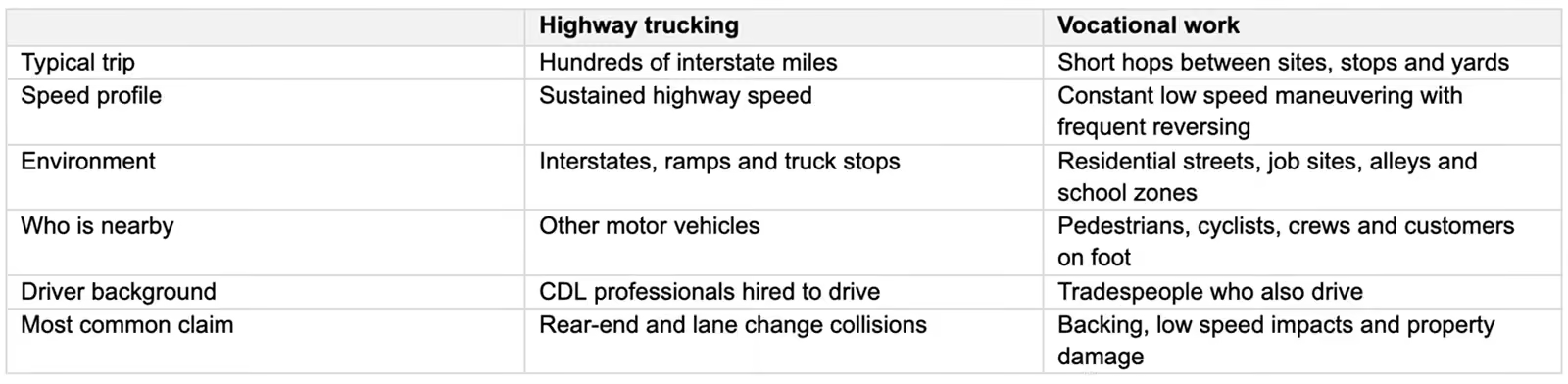
The clearest way to see the gap is side by side. A highway tractor and a vocational truck share little beyond a gross vehicle weight rating. The table below contrasts the two duty cycles on the dimensions that shape risk.
The risks that dominate vocational claims
Claims files tell the story consistently across construction, utilities and waste. Backing and low speed impacts lead the count, since every stop is an improvised loading zone rather than a dock built for trucks. Residential settings put pedestrians and cyclists inside the working envelope of vehicles with large blind zones, and school zones sit on many routes. Loaded dump trucks and concrete mixers carry weight that punishes small misjudgments, because stopping distance and rollover thresholds change with every load.
The human factors differ just as much. Highway fleets fight fatigue on monotonous miles, while vocational drivers fight distraction and time pressure across a day of many small deadlines. A crew running late to the last pour of the day carries its schedule stress onto every street between here and there. None of that shows up in a safety program written for line haul.
What a vocational fleet safety program needs
Video telematics for vocational work has to fit the duty cycle rather than fight it. Multi-camera coverage matters more than in highway work because the risk sits beside and behind the truck, and event verification matters more because urban stop-and-go driving generates far more raw alerts per mile than an interstate does. RideView, our video safety platform, runs the same edge AI on affordable commodity cameras across mixed vocational fleets, verifies every event in the cloud so scores reflect behavior rather than traffic density, and applies one standard across employed crews and subcontractors.
Coaching lands differently with tradespeople than with career drivers, and the framing decides adoption. Position the program as protection for their license, their livelihood and their name on the door, with private in-cab alerts doing most of the correcting. Fleets running this approach have cut distracted driving by up to 70 percent and speeding by up to 50 percent.
Where the highway playbook still applies
The fundamentals do carry over, and a vocational program keeps them. Following distance, phone discipline and speed policies matter on a residential street exactly as they do on an interstate, and vocational fleets should keep those basics in place. What changes is the layer built on top, covering backing, job site approaches and vulnerable road users. Site safety rules such as spotters, cones and exclusion zones remain their own discipline outside anything a vehicle system can see.
Vocational fleet safety FAQ
What is a vocational fleet?
A vocational fleet runs trucks configured for specific work rather than general freight, including dump trucks, concrete mixers, utility bucket trucks, waste collection vehicles, tow trucks and service bodies. Their duty cycle involves many stops, job sites and low speed maneuvering. The risk profile follows the work rather than the miles.
Do non-CDL drivers need the same safety program as CDL drivers?
Yes, because risk follows the vehicle and the route rather than the license class. Many vocational vehicles sit under CDL thresholds while producing claims as severe as any tractor's, especially around pedestrians. A single standard across all drivers also keeps the program defensible if a crash reaches litigation.
Which vocational industry has the highest driving risk?
Waste collection ranks worst, standing as the fifth deadliest occupation in the United States in 2024 at 37.4 deaths per 100,000 workers, with transportation incidents causing most of them. Construction and utility fleets follow, sharing the same mix of backing, residential exposure and time pressure. Every vocational segment shares more risk DNA with each other than with highway trucking.
Build safety around the work your trucks do
Walk one route with one crew and count the stops, the reverses and the people on foot within reach of the vehicle. That count is your risk profile, and our video telematics for vocational fleets page shows how RideView covers it. Request a demo at lightmetrics.co.
Latest in fleet safety.
Why Insurance Leaders Are Betting on Video Telematics to Transform Fleet Risk
Why Insurance Leaders Are Betting on Video Telematics to Transform Fleet Risk
Why Insurance Leaders Are Betting on Video Telematics to Transform Fleet Risk
Get in touch with us.
If you want to learn more or want to consider offering RideView to your fleet customers, Please reach out.