
Why fleet management companies are adding video telematics to their services
Clients expect more than vehicle tracking. Covers video safety as a new revenue line and differentiator for FMCs, delivered under their own brand, with partners roughly doubling revenue per user.
Share


Why fleet management companies are adding video telematics to their services
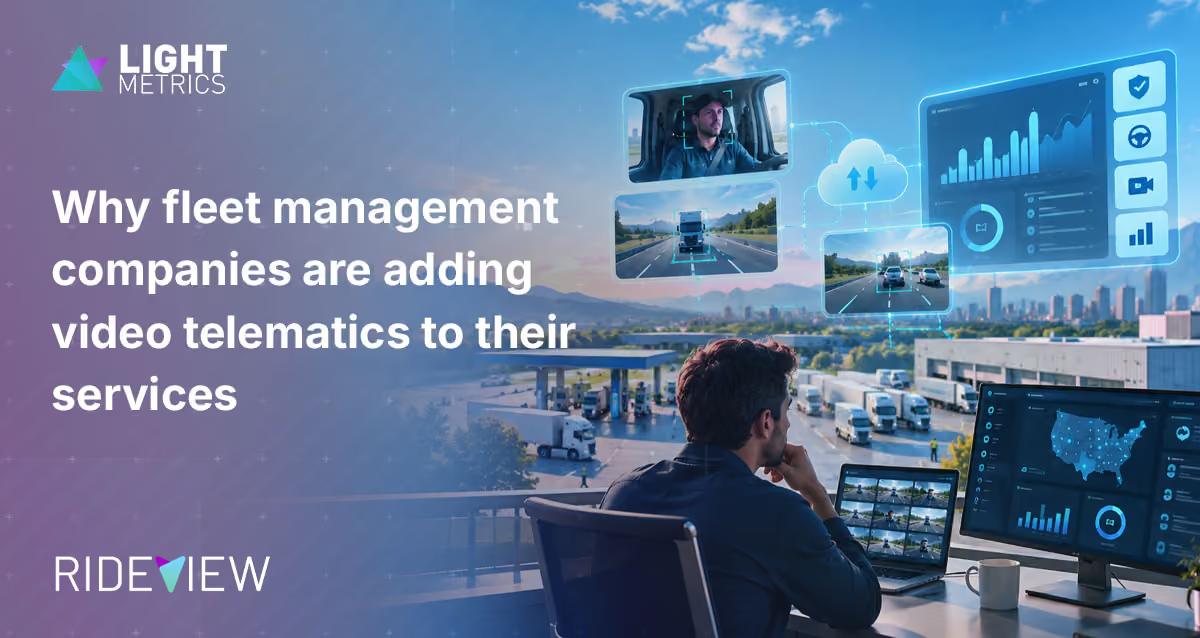
Fleet management companies are adding video telematics because clients now judge them on safety outcomes, insurers reward video evidence, and the service roughly doubles revenue per vehicle for providers who deliver it under their own brand. Vehicle tracking has become table stakes. Video is where the next layer of value, and the next layer of margin, sits.
The market has already made its move. Berg Insight counted almost 7.6 million active video telematics units in North America in 2025 and projects more than 17.3 million by 2030, growing at 18 percent a year, with Europe expanding at a similar pace. Adoption at that scale changes what a managed fleet contract is expected to include. An FMC that cannot offer video safety will increasingly be comparing itself to competitors who can.
What are clients actually asking their FMC for?
The requests reaching account teams have shifted from vehicles and maintenance toward risk. Clients rarely phrase it as video telematics, and the underlying asks map to it directly. Five come up again and again.
• Claims that close faster, with evidence instead of weeks of dispute.
• Visibility into driver risk across their fleet, not just location dots on a map.
• A safety program that works without hiring their own safety department.
• Proof of value in quarterly reviews, with numbers that move.
• One accountable provider, rather than a camera vendor bolted onto the relationship.
Each of those is a service an FMC is structurally better placed to deliver than any point vendor. You already hold the vehicles, the data relationships and the trust. Video telematics turns that position into a program.
The economics of adding a video service line
The revenue case rests on vehicles you already manage. Video telematics adds a recurring per-vehicle subscription to an existing contract, and LightMetrics partners see revenue per user roughly double on average once video is attached. Sales cost stays low because the client relationship, the billing and the fleet data already exist. A ready white label platform compresses launch to weeks, with three weeks being typical for RideView partners, so the line starts earning in the same quarter it is signed.
The retention case may matter even more. Clients who see claims resolve faster, drivers improve and premiums stabilize have a concrete reason to renew, and safety results give account managers something better than cost savings to present. A service that pays the provider and measurably pays the client is rare, which is exactly why the window to offer it first will not stay open long.
Why white label delivery matters
An FMC's brand is the asset in the room, and white label delivery keeps it there. RideView can run fully under your brand, embedded in your existing portal through REST APIs, iFrame and single sign on, so clients experience one platform rather than a handoff to somebody else's app. The AI is hardware agnostic and runs on affordable commodity cameras, which matters when your book spans vans, trucks and mixed client fleets of every age.
Channel structure deserves equal attention. LightMetrics does not sell to fleets directly, so the client relationship stays with the partner, and there is no scenario where your platform provider becomes your competitor. Ask that question of every vendor you evaluate, and ask it early.
What the service line demands from you
A video service is operationally light, and it is not operationally free. Cameras need health monitoring so footage exists when a claim lands, coaching workflows need owners inside each client program, and privacy obligations follow the vehicles across regions. Platforms carry most of that weight when they include camera health monitoring, cloud event verification and certified data practices, which is what lets a lean FMC team run a large book. Budget for client education in the first quarter, since programs succeed when client managers understand what the scores mean.
Video telematics FAQ for fleet management companies
How do fleet management companies make money from video telematics?
The service adds a recurring per-vehicle subscription on top of existing management fees, delivered under the FMC's own brand. Partners typically see revenue per user roughly double once video is attached. Client-side savings on claims and premiums support renewals, so the line earns twice.
Do FMCs need AI expertise to offer video safety?
A white label platform supplies the edge AI, cloud verification, dashboards and apps as a finished stack. Your team runs the client program and the commercial relationship rather than the models. Building in-house is a different decision entirely, which we cover in a separate build versus buy guide.
How long does it take to launch a video telematics service?
With a ready white label platform, weeks rather than quarters. RideView partners typically reach the market in about three weeks, including branding, portal integration and the first client fleets. In-house builds run to years before the first camera ships.
Open the service line your book is waiting for
Count the vehicles already under your management and price a per-vehicle video subscription against them. The infrastructure, the AI and the launch playbook already exist, and our video telematics for fleet management companies page shows how partners run it under their own brand. Talk to us about becoming a partner at lightmetrics.co.
Latest in fleet safety.

Why Insurance Leaders Are Betting on Video Telematics to Transform Fleet Risk
Why Insurance Leaders Are Betting on Video Telematics to Transform Fleet Risk
Why Insurance Leaders Are Betting on Video Telematics to Transform Fleet Risk
Get in touch with us.
If you want to learn more or want to consider offering RideView to your fleet customers, Please reach out.