
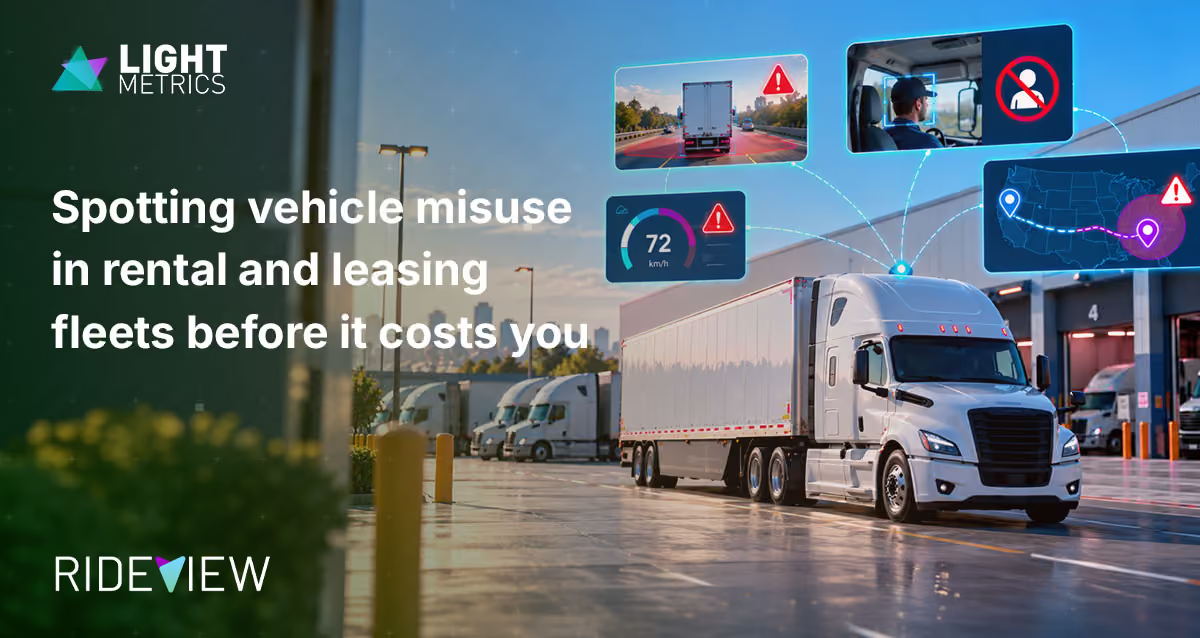
Spotting vehicle misuse in rental and leasing fleets before it costs you
Covers live view, GPS trip data and usage policy enforcement to catch misuse and unauthorized use early, plus longer-term behavior coaching on leases.
Share


Spotting vehicle misuse in rental and leasing fleets before it costs you
Vehicle misuse announces itself in data long before it shows up as an invoice, a total loss or a vehicle that never comes back. Unauthorized drivers, out-of-area trips, commercial abuse and harsh use each leave a distinct pattern in GPS and video records, and operators who watch for those patterns intervene while intervention is still cheap. The alternative is discovering misuse at return, or worse, at renewal, when the costs have already compounded.
The environment is moving in fleet operators' favor. The National Insurance Crime Bureau reported 850,708 vehicle thefts in 2024, down 17 percent from more than a million the year before and the largest annual decline in four decades, crediting better technology and coordinated recovery among the reasons. Connected vehicles are harder to steal quietly and easier to recover quickly, and the same visibility that deters the thief also catches the renter running a side business out of your van. Data has become the difference between operators who find out and operators who pay.
What counts as vehicle misuse?
Misuse covers more ground than theft, and each kind costs differently. An unauthorized driver behind the wheel voids the risk assumptions the agreement was priced on, and often the insurance along with them. Out-of-area use puts vehicles beyond the operator's recovery reach and sometimes across borders where different rules apply. Commercial abuse, such as running gig deliveries or hauling freight in a consumer rental, piles hundreds of unpriced miles and stops onto a vehicle every week. Harsh use, from off-road excursions to chronic redlining and overloading, converts directly into maintenance costs and depressed residual value at disposal.
At the far end sits conversion, the rental that simply never comes back, along with subletting schemes that put your vehicle in circulation on platforms you have never heard of. Every one of these behaviors was invisible in the paper era until the damage was done. All of them are visible now.
The early signals in the data
Each misuse pattern has a signature, and modern platforms surface them automatically rather than waiting for someone to notice. The table below pairs the most common patterns with the signals that expose them early.
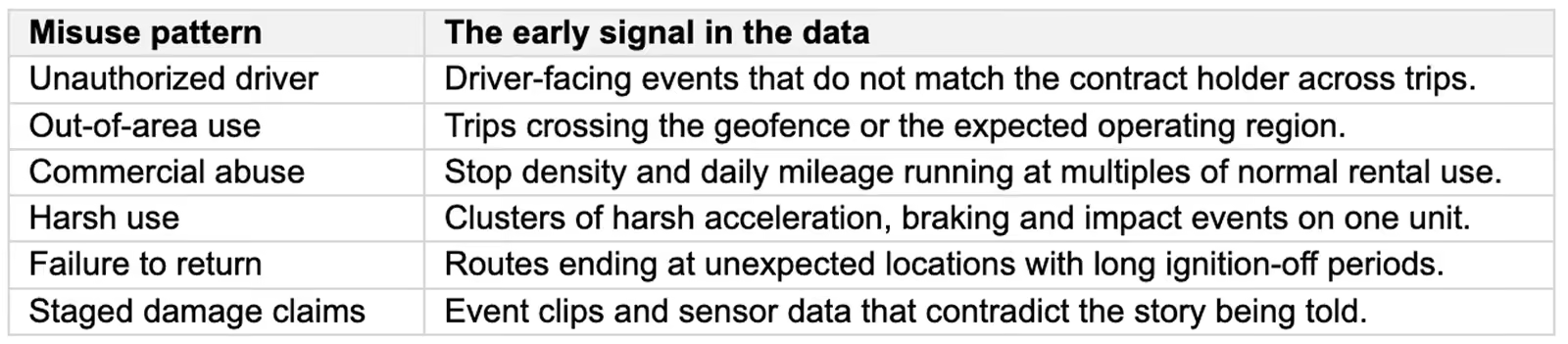
None of these signals requires watching screens all day. Thresholds and automated flags do the monitoring, and a human looks only at the trips that earn attention. The fleet's normal defines the baseline, so a pattern that would be routine for one operator stands out clearly for another.
Act early, and act proportionately
The escalation ladder matters as much as the detection. A flag starts with a look at the trip data, most flags end there with an innocent explanation, and the ones that do not lead to a customer conversation grounded in specifics rather than suspicion. Live view and GPS location support the rare cases where conversion is suspected and recovery or police involvement follows, with evidence ready rather than guesswork. On leases, the same data feeds scheduled reviews instead of surprise accusations, where a pattern of harsh use becomes a conversation about policy, cost sharing or driver coaching within the client's fleet. Operators who act early protect the asset, and operators who act proportionately keep the customer.
Enforcement only works when the paperwork got there first. Usage terms, permitted drivers, operating areas and monitoring disclosure all belong in the agreement, written clearly enough that a flagged customer cannot claim surprise. The data proves what happened, and the contract decides what happens next.
Data flags, contracts decide
A monitoring program earns trust by being right and being fair, which sets real requirements on both the technology and the process. False flags exist, since a legitimate customer sometimes drives far, stops often or hits a pothole hard, and a human review belongs between every automated flag and every accusation. Privacy expectations and law vary by market, so keep monitoring event-based and proportionate, and store data regionally where rules require it. Misuse detection is a loss-prevention tool, and the moment it feels like surveillance to ordinary customers it starts costing more than it saves.
Unauthorized vehicle use FAQ
How do rental companies detect unauthorized drivers?
Driver-facing cameras with on-device AI notice when the person driving does not match across trips or against the contract, and flag the mismatch for review. GPS patterns add context, such as trips starting from locations tied to someone other than the customer. Confirmation always goes through human review before any action.
Can telematics prevent rental vehicle theft?
It deters theft and dramatically improves recovery. Connected vehicles report location continuously, which shortens the window a stolen unit stays missing, and national theft numbers fell 17 percent in 2024 partly on the strength of better vehicle technology. For conversion cases, the trip history usually points recovery efforts to the right place within hours.
Does misuse monitoring hurt the customer experience?
Not when it is disclosed and proportionate, since ordinary customers never encounter it. Monitoring runs on thresholds that normal use never crosses, and the honest majority benefits from lower losses, better-maintained vehicles and pricing that is not subsidizing abuse. The customers who object loudest tend to be the ones the program exists for.
Find the trips that deserve a second look
Ask your operations team which vehicles came back last quarter with damage, mileage or wear nobody could explain. Our video telematics for rental and leasing fleets page shows how RideView surfaces the pattern behind those returns while there is still time to act. Request a demo at lightmetrics.co.
Latest in fleet safety.
Why Insurance Leaders Are Betting on Video Telematics to Transform Fleet Risk
Why Insurance Leaders Are Betting on Video Telematics to Transform Fleet Risk
Why Insurance Leaders Are Betting on Video Telematics to Transform Fleet Risk
Get in touch with us.
If you want to learn more or want to consider offering RideView to your fleet customers, Please reach out.