
Keeping rental vehicles safe no matter who is behind the wheel
Every rental trip can introduce an unfamiliar driver. Covers real-time in-cab alerts that guide any driver from the first mile and per-trip risk visibility across high turnover fleets.
Share


Keeping rental vehicles safe no matter who is behind the wheel
Rental fleet telematics solves a problem no other safety program faces: the driver is a stranger. There is no hiring screen, no orientation and no coaching relationship, because the customer signed twenty minutes ago and drives away in a vehicle they have never sat in. Real-time in-cab guidance and per-trip risk scoring protect the vehicle anyway, since they work on first exposure and need no training to be understood. A voice alert saying the gap is closing means the same thing to every driver on earth.
The habits arriving with each customer are a lottery with known odds. GHSA and Cambridge Mobile Telematics put the crash risk of phone use behind the wheel at 240 percent of baseline, and some share of every day's renters carry exactly that habit into your vehicle. Others will drive a box truck for the first time in their lives, misjudge its height and its stopping distance, and learn on your asset. A rental operator cannot select drivers the way an employer can, which means safety has to travel with the vehicle rather than the driver.
Why is rental driving riskier than fleet driving?
Every trip resets the risk profile to unknown. An employed driver accumulates history, scores and coaching over months, while a renter presents a license and a payment card that says nothing about following distance. The vehicle itself is unfamiliar territory, since mirrors, dimensions, braking feel and blind zones differ from whatever the customer normally drives, and the difference peaks with vans and trucks rented to people who have only driven cars. Incentives finish the picture, because a driver who does not own the asset and returns it in three days simply does not carry an owner's caution.
Commercial rental sharpens each of those edges. Businesses rent vehicles for temp drivers, seasonal surges and borrowed workers, which means the person behind the wheel may be several steps removed from anyone who signed the agreement. Utilization pressure keeps vehicles moving between customers with little time in between, so small damage and developing risks pass unnoticed from one rental to the next. High turnover is the business model, and it is also the exposure.
What works when you cannot train the driver
The tools that work share one property, which is that they operate inside the trip rather than before it. Five carry most of the weight.
• Instant voice alerts that correct distraction, tailgating and speeding the moment they happen, with no orientation required.
• Per-trip risk scoring that treats each rental as its own record, so risk is visible even with a different driver every day.
• Speed and zone context, flagging the trip that runs highway speeds through residential areas or leaves the expected region.
• Live view and GPS for escalation, when a trip's pattern suggests the situation needs a human decision.
• Event video that documents every incident for the claims file, whoever was driving.
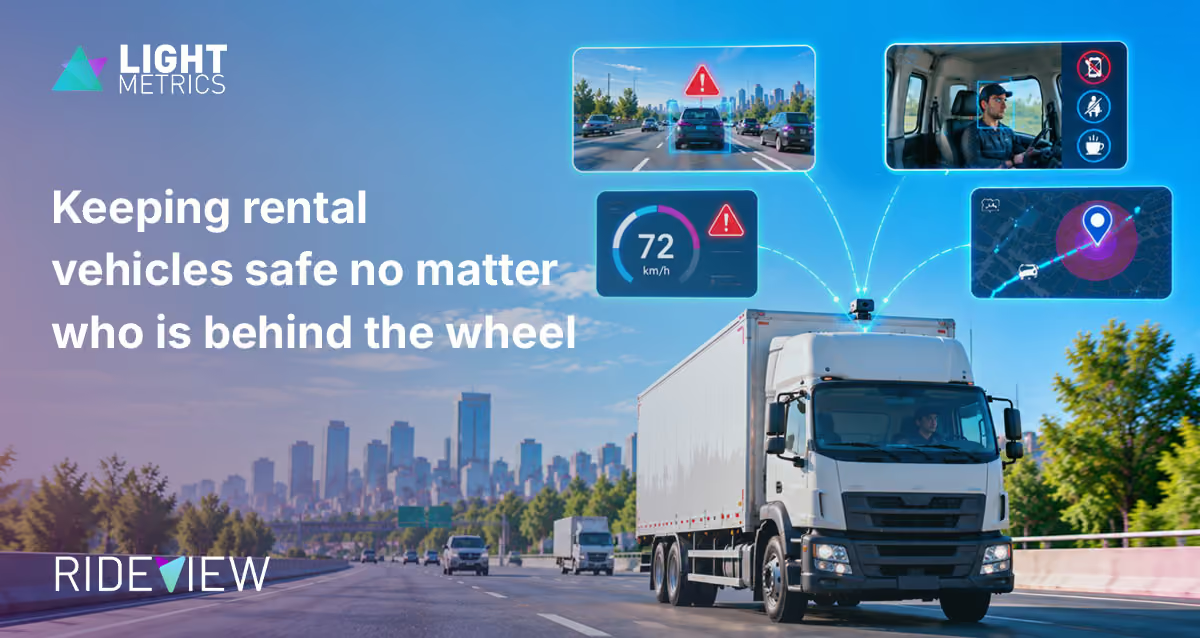
RideView, our video safety platform, was built for exactly this per-trip world. Edge AI monitors each rental on its own terms, uploads only event clips, and produces consistent trip records across a fleet where no two days share a driver. Across fleets running the platform, distracted driving has fallen by up to 70 percent and speeding by up to 50 percent, and in rental fleets that improvement arrives without a single coaching session, because the correction happens in the cab.
Long-term leases are a different game
Leasing restores the relationship that rental lacks, and the same data grows more valuable with time. Over a multi-year contract, trip records build into trends a lessor can bring to account reviews, showing a client fleet's risk trajectory, its outlier drivers and the behavior behind its maintenance bills. Harsh acceleration, hard braking and curb strikes convert directly into tire, brake and suspension costs, and a lessee shown that connection in numbers tends to act on it. Residual value rides on the same behavior, since the vehicle coming off lease carries every one of those events in its bones.
The lease conversation also changes what coaching means. A lessor cannot coach a renter and can absolutely help a lessee build coaching into their own operation, using the scores and clips the platform already produces. That turns the lessor from a source of invoices into a partner in the client's safety program, which is a stickier commercial position at renewal time.
What guidance cannot do with a stranger
In-cab alerts curb risky moments, and they do not transform a determined renter into a careful one. Screening, deposits, contract terms and the occasional refusal to rent remain the tools for the customer whose history or behavior says no, and no camera substitutes for them. Disclosure belongs in every agreement, since guidance systems and recording must be presented clearly to stay fair and lawful across markets. The platform holds the floor under every trip, and the business still decides who gets the keys.
Rental fleet telematics FAQ
Do in-cab alerts work for drivers who have never used them?
Yes, and first-time drivers are where they work best. A spoken alert about tailgating or phone use needs no explanation, no app and no setup, so it lands with a renter exactly as it lands with a veteran employee. The correction happens in the moment, which is the only moment a rental operator gets.
Can rental companies monitor how customers drive?
Generally yes, with disclosure in the rental agreement and a program designed around events rather than continuous surveillance. Requirements vary by jurisdiction, particularly for driver-facing cameras, so operators should confirm local rules in each market. Event-based capture with on-device processing keeps monitoring proportionate to the purpose.
What is per-trip risk scoring?
Per-trip scoring evaluates each rental as a standalone record, using the same verified events and math across every trip. It gives operators risk visibility without needing driver history, flags the trips that deserve attention while they are still underway, and builds a fleet-level picture from thousands of individual rentals. In leasing, the same scores accumulate into driver and fleet trends over the contract.
Put a floor under every trip
Think about how many strangers drove your fleet last week and how much you knew about any of them. Our video telematics for rental and leasing fleets page shows how RideView guides every driver from their first mile in the vehicle. Request a demo at lightmetrics.co.
Latest in fleet safety.
Why Insurance Leaders Are Betting on Video Telematics to Transform Fleet Risk
Why Insurance Leaders Are Betting on Video Telematics to Transform Fleet Risk
Why Insurance Leaders Are Betting on Video Telematics to Transform Fleet Risk
Get in touch with us.
If you want to learn more or want to consider offering RideView to your fleet customers, Please reach out.