
Settling customer disputes with video and GPS proof in field service
Was the technician on site, and did the incident happen as reported? Covers using on-demand video and timestamped trip data to resolve billing and liability disputes and verify service activity.
Share


Settling customer disputes with video and GPS proof in field service
Most field service disputes come down to a single question: what happened, and when? Video and GPS give you proof of service, a timestamped record of where a technician was, how long the visit lasted and what took place on the road, so disputes settle on evidence in minutes rather than on memory over weeks. The same record protects technicians when an accusation is unfair.
Disputes in field service go well beyond accidents. Customers question whether a visit happened, how long it lasted and whether the billed hours match reality, while neighbors and other drivers occasionally blame a branded van for damage it never caused. Every one of those arguments costs office time, sours a relationship and often ends in a goodwill credit that nobody owed.
What counts as proof of service in a dispute?
Proof of service is evidence that a visit happened as billed: who attended, when they arrived, how long they stayed and what condition things were in. Signed work orders once carried that weight on their own, and they still leave room for argument about times and details. GPS trip data and vehicle video close that gap because both are timestamped, automatic and independent of anyone's recollection.
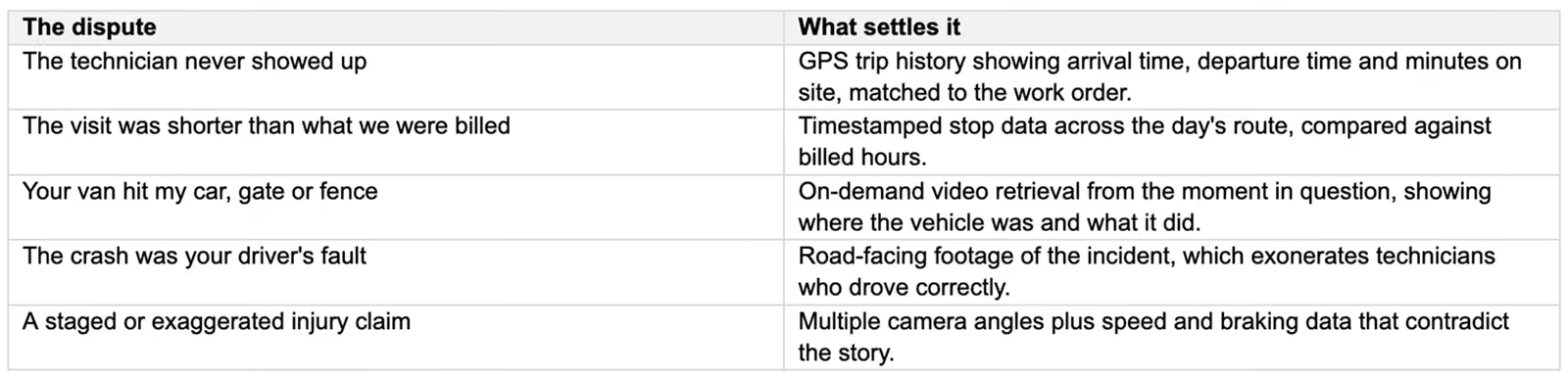
Different disputes call on different parts of that record. The table below shows the five arguments service leaders hear most often, alongside the evidence that ends each one. Most take minutes to pull once the data exists.
How video and GPS evidence works day to day
The evidence collects itself, which is what makes the approach practical. Cameras record continuously to local storage while the vehicle operates, edge AI flags notable events, and short clips upload automatically with time and location attached. GPS logs every trip in parallel, so arrival and departure stamps exist for each stop whether or not anything went wrong.
Retrieval matters as much as recording. When a dispute surfaces days later, on-demand DVR access lets a manager pull footage from a specific window instead of relying on what happened to trigger an alert. RideView, our video safety platform, pairs that retrieval with APIs and single sign on, so evidence sits alongside the dispatch and work order systems your office already uses. We process more than 15 million miles of video, GPS and sensor data every month, which means the record is there when you need it.
What faster dispute resolution is worth
Fraudulent and exaggerated claims are a measurable drain on every business that operates vehicles. A study for the Coalition Against Insurance Fraud put the cost of insurance fraud at $308.6 billion a year in the United States, a figure state regulators such as the North Carolina Department of Insurance still cite in 2025, and vehicle claims are a steady contributor. Video evidence lets your insurer close the questionable ones quickly, which shows up over time in premiums and claim outcomes.
The quieter savings sit in the office. A dispute that once meant days of calls, statements and negotiated credits becomes a five minute clip review, and the customer relationship usually survives because the conversation moves from blame to fact. Technicians feel the difference too, since a company that can prove what happened rarely asks them to absorb an unfair accusation.
A proof of service checklist for disputed visits
Evidence only settles a dispute if someone captures it while it still exists. Onboard storage overwrites itself after a set period, memories fade and paperwork scatters across systems. When a customer or third party raises an issue, work through this list the same day.
☐ Pull GPS arrival and departure stamps for the visit and match them to the work order.
☐ Compare time on site against the hours billed before anyone calls the customer back.
☐ Retrieve event clips and DVR footage covering the window in question, before it ages out of storage.
☐ Save video, trip data and photos to the job record so the file survives staff changes.
☐ Share the relevant clip with the customer or insurer once the facts are clear.
Where video and GPS proof reaches its limits
Vehicle evidence covers the road and the driveway, and it stops at the front door. What happens inside a home or plant still depends on job photos, notes and signatures in your field service software, so treat vehicle data as one layer of a wider record. Retention windows are finite as well, which is why the checklist above starts the same day.
Transparency keeps the program defensible. Tell customers and technicians what is recorded and why, set a clear retention policy, and involve your insurer early on contested claims. Evidence works best when nobody can question how it was gathered.
Proof of service FAQ
Can GPS records alone settle a billing dispute?
GPS alone settles many of them. Timestamped arrival and departure data answers when a technician was on site and for how long, which resolves most disagreements about visits and billed hours. Video earns its keep on the harder cases, such as damage claims and accident liability, where location alone proves little.
How long is footage available after an incident?
Event clips upload to the cloud when they happen and stay retrievable long term. Continuous footage lives on the camera's local storage and overwrites itself, typically within days to weeks depending on hardware and settings. Prompt retrieval is therefore part of any good dispute process.
Will insurers accept dash cam video as evidence?
Insurers routinely accept timestamped video in claims, and it frequently shortens investigations by removing the argument over what happened. Courts in most jurisdictions admit it as well when it is relevant and authentic. Ask your carrier how they want footage submitted so it enters the file cleanly.
Turn your next dispute into a five minute conversation
Think about the last disputed visit your office handled and how many hours it consumed before anyone saw evidence. RideView puts video and GPS proof behind every vehicle in your fleet, inside the dispatch tools you already run, and you can read how it fits service operations on our video telematics for field service fleets page. Request a demo at lightmetrics.co.
Latest in fleet safety.

Why Insurance Leaders Are Betting on Video Telematics to Transform Fleet Risk
Why Insurance Leaders Are Betting on Video Telematics to Transform Fleet Risk
Why Insurance Leaders Are Betting on Video Telematics to Transform Fleet Risk

Get in touch with us.
If you want to learn more or want to consider offering RideView to your fleet customers, Please reach out.