
What nuclear verdicts mean for trucking fleets and how video helps
Lawsuit awards against carriers keep climbing. Covers how HD video evidence exonerates not-at-fault drivers and how a documented safety program reduces litigation exposure.
Share


What nuclear verdicts mean for trucking fleets and how video helps
A nuclear verdict is a jury award exceeding $10 million, and in trucking they have moved from rare shock to planning assumption. ATRI's latest litigation research puts the median nuclear verdict at $36 million, roughly 50 percent higher than a decade earlier. Video evidence and a documented safety program are the two strongest defenses a fleet actually controls.
The trend lines all point the same direction. Tractor-trailer tort filings grew at 3.7 percent a year from 2014 through 2023, verdicts above $50 million claimed a growing share of outcomes, and in more than 80 percent of verdicts over $1 million the non-medical damages ran up to ten times the medical bills. Numbers like that are why insurance premiums keep climbing for carriers with clean records. Every fleet is paying for these verdicts, whether or not it ever sees a courtroom.
Why are verdicts against trucking fleets so large?
The size comes from strategy rather than from the crashes themselves. Plaintiff attorneys increasingly put the carrier's conduct on trial instead of the collision, working through hiring files, maintenance records, training logs and technology choices in discovery. The approach is often called reptile theory, a tactic that frames the carrier as an ongoing danger to the community so the jury punishes the company rather than weighing one event. Litigation funding gives plaintiffs the patience to push cases toward trial, and a corporate defendant against an injured person is a hard posture to win from without evidence.
Venue amplifies the problem. ATRI found the median award in state courts reached $3.6 million for cases over $1 million, against $2.5 million in federal courts, and estimated the industry lost $102.8 million in 2022 to excess awards in state venues alone. Settlements above $5 million ran statistically lower than verdict awards, which means carriers with weak evidence often settle high simply to escape the jury.
How video changes each stage of a claim
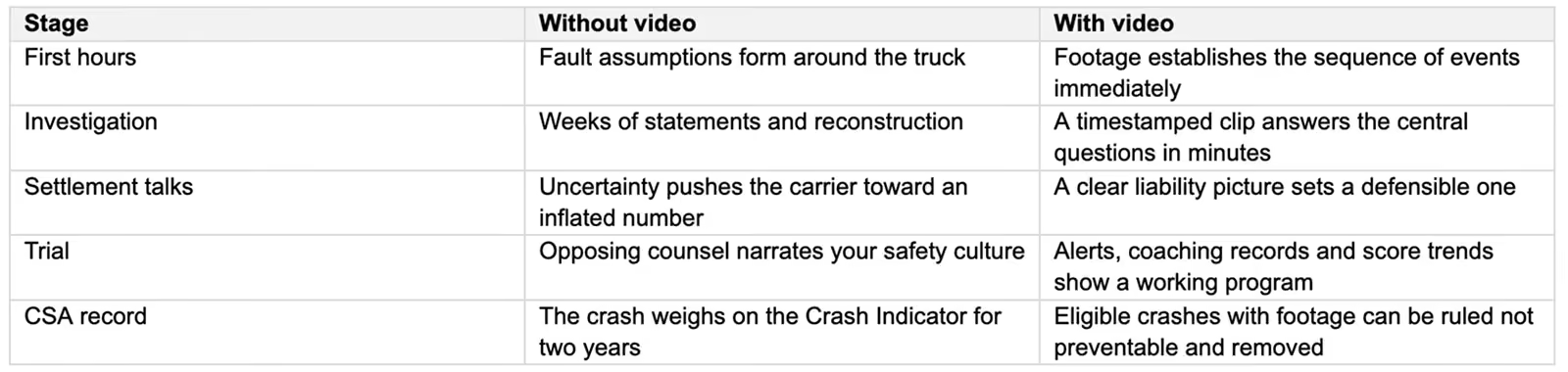
The value of footage is easiest to see stage by stage. A claim hardens early, and whatever evidence exists in the first days sets the trajectory. The table below follows one serious crash down both paths.
A documented safety program is the defense juries respect
Juries punish indifference far more harshly than error. Discovery exposes what a fleet knew about its risks and what it did in response, which is exactly where reptile theory hunts. A program with real-time in-cab alerts, verified coaching records and improving scores demonstrates ordinary care in the language courts use, and it converts the safety culture question from a vulnerability into an exhibit. The absence of available safety technology has itself become a plaintiff argument, presented to juries as a company that chose not to know.
This is where video telematics earns its place beyond the crash clip. RideView corrects risky moments in the cab before they become collisions, logs every coached event, and shows fleet-level trends such as distracted driving down by up to 70 percent. Records like that end many claims early, since a plaintiff attorney reading a strong safety file knows the community-danger narrative will not hold.
What video cannot do in court
Video is honest in both directions, and fleets should plan for that. Footage of a preventable crash with no coaching follow-up behind it strengthens the plaintiff's file, and clips deleted outside a defensible retention policy invite spoliation claims that can hurt more than the footage would have. Counsel and the insurer belong in the process early, with clear rules on retention and release. The camera protects fleets that run a real program and documents the ones that do not.
Verdicts also feed on gaps a camera never touches. Maintenance shortcuts, hours-of-service pressure and thin hiring standards all surface in discovery regardless of what the video shows. Treat video as one pillar of a defense built on the whole operation.
Nuclear verdicts FAQ for trucking fleets
What is a nuclear verdict in trucking?
A nuclear verdict is a jury award above $10 million against a motor carrier. ATRI's research puts the median at $36 million as of 2022, about 50 percent higher than ten years earlier, with awards above $50 million growing as a share of outcomes. The label matters less than the trend, since even sub-nuclear awards now routinely exceed policy limits.
Does dash cam footage help or hurt in a lawsuit?
Footage helps fleets whose drivers drove correctly, and it helps quickly, often ending claims before filing. When the footage shows a preventable crash, it still serves the fleet by supporting an early, fairly priced settlement instead of a runaway trial. What juries ultimately weigh is the coaching record around the footage, which shows whether the fleet acted on what it knew.
Can a safety program really lower a verdict?
Documented ordinary care undercuts the punitive narrative that produces nuclear numbers. Real-time alerts, verified coaching logs and improving fleet trends give the defense exhibits instead of assurances. Insurers read the same file, which is why documented programs increasingly shape both premiums and coverage terms.
Build the record before you need it
Every fleet eventually faces the claim, and the only question is what evidence will exist on that day. RideView builds the record continuously, from exoneration footage to coaching logs to fleet trends, inside the telematics platform you already run. Our video telematics for transportation and logistics fleets page shows how carriers put it to work. Request a demo at lightmetrics.co.
Latest in fleet safety.
Why Insurance Leaders Are Betting on Video Telematics to Transform Fleet Risk
Why Insurance Leaders Are Betting on Video Telematics to Transform Fleet Risk
Why Insurance Leaders Are Betting on Video Telematics to Transform Fleet Risk
Get in touch with us.
If you want to learn more or want to consider offering RideView to your fleet customers, Please reach out.