
The biggest safety risks on mine haul roads and how AI dash cams address them
Haul truck blind spots, dust and low visibility, and interactions between heavy and light vehicles. Covers how edge AI alerts prevent incidents on site.
Share


The biggest safety risks on mine haul roads and how AI dash cams address them
Haul roads, the private routes that move ore, waste and people around a mine site, produce more vehicle deaths than any other part of mining. MSHA closed 2025 with 33 miner fatalities, up 27 percent from 26 the year before, and powered haulage led every accident category with 13 of those deaths. AI dash cams address the haul road share of that toll directly, watching the road and the operator at once and correcting risk in the moment it forms.
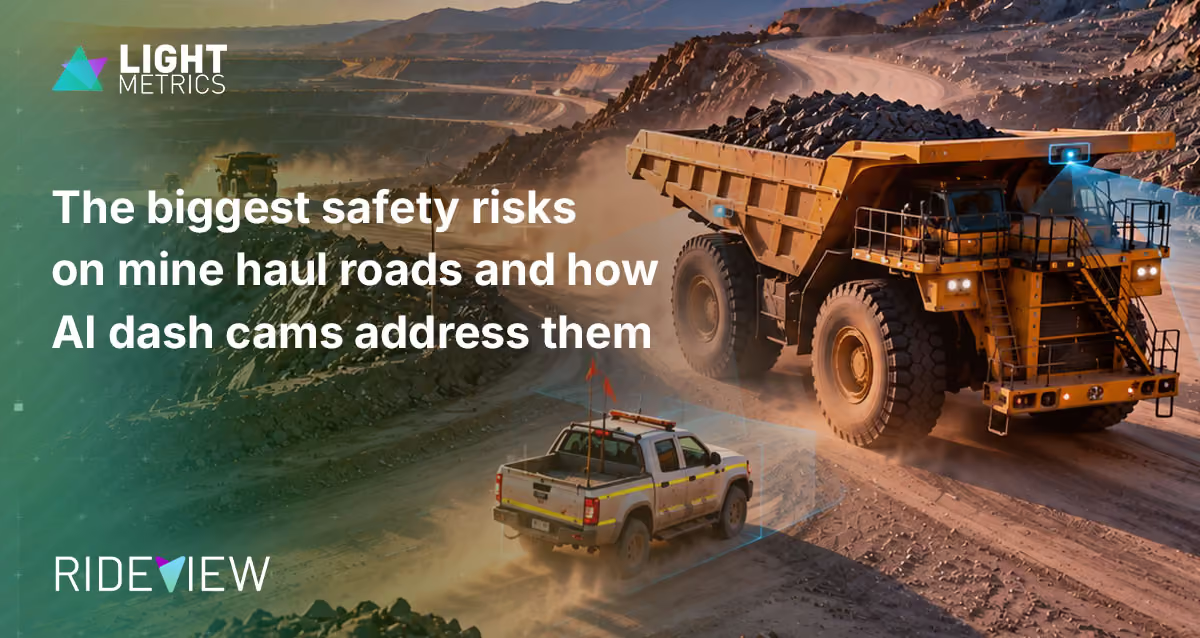
The setting explains the severity. A loaded ultra-class haul truck outweighs a light vehicle by several hundred to one, sight lines are blocked by the truck's own body, and the road itself changes with weather, grading and the day's mine plan. Everything that makes a mine productive also makes its roads unforgiving, which is why mining fleet safety starts with the haul road rather than the highway rules written for public traffic.
Why do haul road incidents keep happening?
Scale asymmetry does most of the damage. Haul trucks carry blind zones large enough to hide a pickup entirely, and the deadliest routine interaction on most sites is between a heavy hauler and the light vehicles that service it. Dust, night operations and rain strip away visibility exactly where margins are thinnest, on ramps, intersections and dump edges. Radio protocols and positive communication rules help until a channel gets busy or a driver assumes, and assumptions at 90 tonnes settle arguments permanently.
Repetition quietly compounds the risk. An operator runs the same circuit dozens of times a shift, hundreds of times a swing, and familiarity breeds the micro-shortcuts that precede incidents, a rolled stop at a junction here, a following gap shaved there. Site speed rules exist on paper and drift in practice when nobody is watching between audits. The gap between written procedure and cab behavior is exactly the gap AI monitoring closes.
The biggest risks and how AI dash cams answer them
The table below pairs the risks that dominate haul road incident reports with the way in-cab AI addresses each one. Every response happens in real time, on the vehicle, without waiting for connectivity or a supervisor.

Edge processing makes all of it work where mines operate. The AI runs on the camera itself, so detection and alerts continue in pit areas with no coverage, and event clips upload when connectivity returns. Verified events reach supervisors with the false positives already filtered, which matters on sites where dust and vibration would otherwise bury real risks in noise.
From single alerts to a site picture
The alerts correct moments, and the pattern behind them corrects the site. Verified events mapped by zone, shift and hour show supervisors where risk concentrates, whether that is a junction that produces near misses every night shift or a crew whose following distances collapse in the last two hours of a swing. Coaching conversations run on twenty second clips instead of recollections, which keeps them short and keeps them fair. Fleets running RideView, our video safety platform, have cut distracted driving by up to 70 percent and speeding by up to 50 percent, and on a mine site those behaviors sit directly upstream of the incidents MSHA counts.
Light vehicles deserve equal coverage, and usually get none. Utes, service trucks and crew buses interact with heavy equipment all day, and because the platform is hardware agnostic and runs on affordable commodity cameras, extending the same detection across the whole mixed fleet is a rollout decision rather than a budget crisis. The site picture is only complete when every vehicle contributes to it.
What cameras do not replace on a mine site
AI dash cams join a layered system rather than substituting for it. Traffic management plans, segregation, berms and positive communication remain the backbone of haul road safety, and dedicated proximity or collision avoidance systems mandated in some jurisdictions do work the camera does not attempt. What video adds is the operator-state layer and the evidence layer, seeing the fatigue, distraction and behavior that other systems cannot, and recording what happened when investigations need truth instead of testimony. Sites get the best results treating the technologies as complements with one shared goal.
Mining fleet safety FAQ
What is the leading cause of mining vehicle deaths?
Powered haulage, the category covering haul trucks and mobile equipment, led MSHA's 2025 fatality statistics with 13 of 33 deaths. The category has topped or led mining accident classifications for years. Haul road interactions between heavy and light vehicles account for a large share of it.
Do AI dash cams work without cell coverage?
Yes, when the AI runs on the device. Detection and in-cab alerts operate fully offline, clips buffer locally, and uploads complete when the vehicle returns to coverage. Mines should confirm on-device processing specifically, since cloud-dependent systems go quiet exactly where the pit needs them.
How do dash cams fit with collision avoidance systems?
As a complementary layer. Collision avoidance and proximity systems track vehicle positions and intervene on trajectories, while AI dash cams read the operator and the road scene, catching fatigue, distraction and behavior upstream of any proximity breach. Together they cover the machine, the moment and the person.
See your haul roads the way the data does
Ask your site team which junction, ramp or shift they worry about most, then imagine answering with verified events instead of hunches. Our video telematics for mining fleets page shows how RideView works where your trucks do. Request a demo at lightmetrics.co.
Latest in fleet safety.
Why Insurance Leaders Are Betting on Video Telematics to Transform Fleet Risk
Why Insurance Leaders Are Betting on Video Telematics to Transform Fleet Risk
Why Insurance Leaders Are Betting on Video Telematics to Transform Fleet Risk
Get in touch with us.
If you want to learn more or want to consider offering RideView to your fleet customers, Please reach out.