
How to keep last mile drivers safe without slowing deliveries
Dense routes, tight windows, pedestrian-heavy areas and high driver turnover. Covers real-time alerts and coaching that improve safety without hurting delivery times.
Share


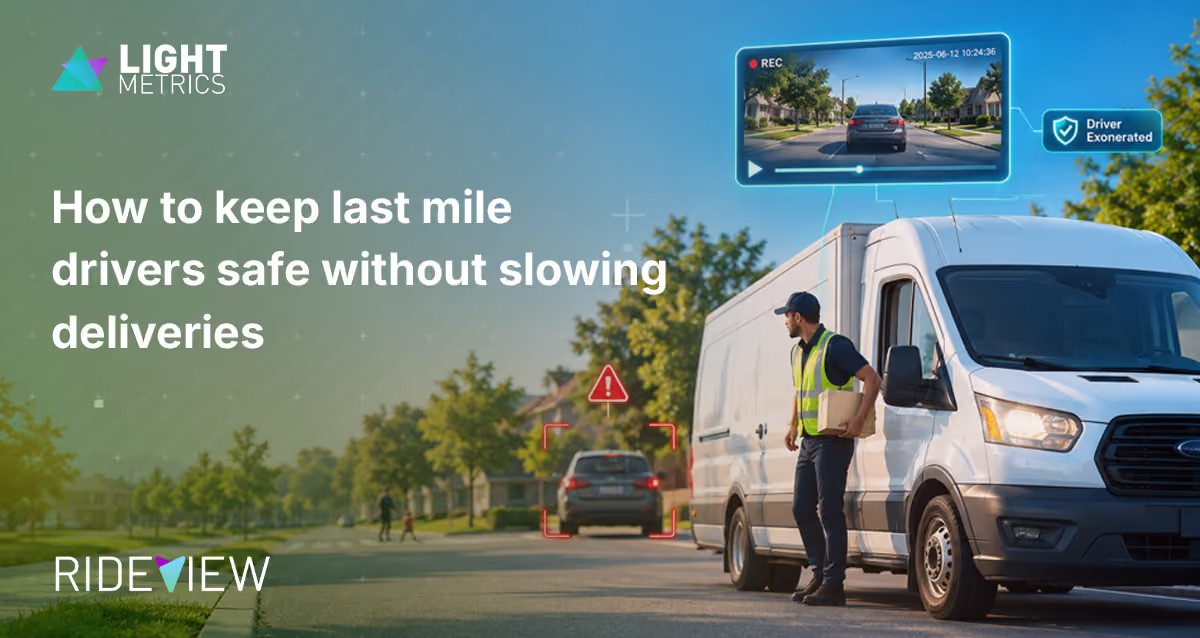
How to keep last mile drivers safe without slowing deliveries
Last mile delivery safety and delivery speed are the same goal wearing different badges. A crash removes a route from service for a day or more, while the in-cab alert that would have prevented it costs a second of attention, which means the fastest fleets over a quarter are reliably the safest ones over a week. The tradeoff most operations managers fear, protecting drivers at the cost of stops per hour, does not survive contact with the math.
The environment last mile works in raises the stakes. GHSA reported US pedestrian deaths fell 11 percent in the first half of 2025, a second straight year of welcome decline, and fatalities still run far above the levels of a decade ago. Delivery vans do their work precisely where pedestrians are, on residential streets, outside schools and across parking lots, dozens of times per route. A last mile fleet's safety record is written in the most sensitive traffic environment there is.
Why does last mile work create its own risk?
The duty cycle concentrates exposure into every hour. A driver making a hundred stops performs a hundred arrivals, a hundred departures and dozens of reverses, threading residential streets where children, cyclists and dog walkers share the space, all against delivery windows that get tighter every year. Navigation and delivery apps keep the phone alive in the cab by design, so distraction is baked into the workflow rather than smuggled in. Each stop is routine, and a hundred routines a day is how low-probability events become weekly ones.
Staffing patterns multiply the exposure. Last mile runs on high turnover and seasonal surges, which means a meaningful share of any week's drivers are new to the route, the vehicle or the job itself. Training time is short by economic necessity, and peak season compresses it further. A safety approach that depends on experience will always be one hiring wave behind reality.
Speed and safety are the same problem
Run the numbers on a single incident. A collision takes a van and a driver out of service, strands a route's parcels for reassignment, triggers claims work and customer complaints, and can cost more delivery capacity in one day than every safety intervention combined costs in a quarter. Real-time voice alerts prevent a large share of those incidents by correcting distraction, tailgating and speeding in the moment, privately, without pulling the driver over for a conversation. Fleets running RideView, our video safety platform, have cut distracted driving by up to 70 percent and speeding by up to 50 percent, and none of that improvement subtracted a stop from anyone's route.
Risk data also fixes the schedule pressure at its source. When verified events cluster on a route, at a time of day or around a depot's dispatch pattern, the problem is often the plan rather than the driver, and route design is a fixable input. Coaching stays for patterns that follow a driver across routes, while planning absorbs the rest. Fleets that read the data this way stop asking drivers to choose between the window and the crosswalk.
A peak season safety checklist
Peak season stacks every risk factor at once, with new drivers, extended hours, winter conditions and maximum parcel volume arriving together. The fleets that hold their safety numbers through Q4 prepare in September rather than November. This checklist covers the preparation that matters.
☐ Baseline your risk data now, so peak weeks are measured against a known normal.
☐ Put in-cab alerts on every vehicle before seasonal hiring starts, since alerts coach from the first mile.
☐ Brief seasonal drivers on the alert system on day one, framed as protection rather than surveillance.
☐ Set message-hold rules so dispatch traffic waits until the vehicle stops.
☐ Watch backing events per hundred stops weekly, the earliest indicator of pressure building.
☐ Recognize clean records publicly through the season, because seasonal drivers respond to visible standards.
What alerts cannot fix in last mile
In-cab technology covers the driving and stops at the curb. Route plans that overpromise windows will keep manufacturing pressure no matter what the cab says, sidewalk hazards during the walk to the door sit outside any vehicle system, and loading practices that bury the next parcel add minutes that drivers try to reclaim on the road. Seasonal hiring quality still sets the floor, since alerts guide willing drivers and cannot supply judgment. Treat the vehicle program as the strongest layer in a system that also includes planning, loading and hiring.
Last mile delivery safety FAQ
Do safety programs slow down deliveries?
No, and the arithmetic runs the other way. Alerts cost moments of correction, while a single collision costs a route for a day or more, plus claims and customer recovery. Fleets that cut risky driving events consistently protect more delivery capacity than any pace optimization recovers.
How do you keep seasonal delivery drivers safe?
Put the protection in the vehicle rather than in tenure. In-cab alerts work from a driver's first mile, per-trip scoring flags who needs early attention, and simple rules like message-hold during driving remove the worst temptations. Early recognition for clean driving sets the standard faster than any handbook.
What is the biggest safety risk in last mile delivery?
The combination of pedestrians and repetition. Vans work all day in the environments where people on foot are densest, and backing plus low speed maneuvers at a hundred stops compound small probabilities into regular events. Programs that prioritize vulnerable road user awareness and backing discipline address the largest share of last mile claims.
Hold your numbers through the busiest quarter
Look at last year's Q4 incident list next to this year's route plan and ask what has changed in your favor. Our video telematics for supply chain fleets page shows how RideView protects delivery capacity at full pace. Request a demo at lightmetrics.co.
Latest in fleet safety.
Why Insurance Leaders Are Betting on Video Telematics to Transform Fleet Risk
Why Insurance Leaders Are Betting on Video Telematics to Transform Fleet Risk
Why Insurance Leaders Are Betting on Video Telematics to Transform Fleet Risk
Get in touch with us.
If you want to learn more or want to consider offering RideView to your fleet customers, Please reach out.