
Should fleet management companies build or buy video AI
The build vs partner decision. Covers time to market, white label delivery inside the FMC's own platform, hardware flexibility and avoiding channel conflict.
Share


Should fleet management companies build or buy video AI
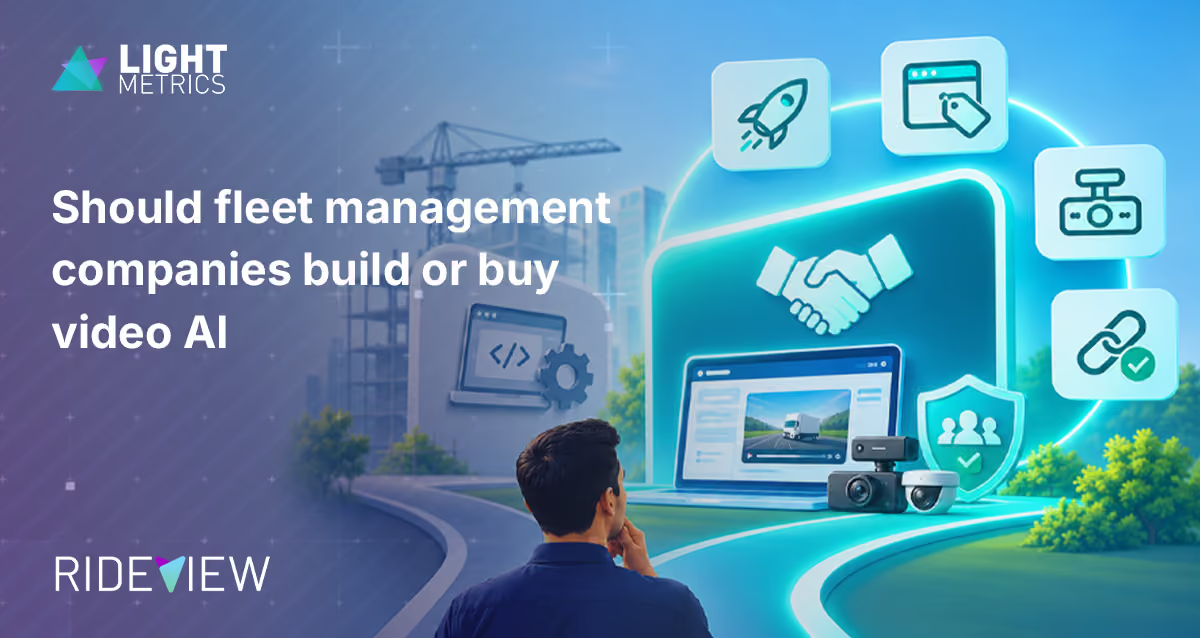
For nearly every fleet management company, buying wins. White label video telematics puts a finished AI stack under your brand in weeks, while building in-house means years of model development, data collection and hardware validation before the first client sees value. Building only makes sense for a company whose core product is the AI itself, with the team and patience to match.
The scope of the build is what most evaluations underestimate. Video AI in production means edge models running on cameras, a cloud layer that revalidates events, coaching workflows, driver scoring, camera health monitoring, mobile apps and APIs, all maintained as roads, vehicles and behaviors change. A detection model is maybe a tenth of the work. The rest is the decade of unglamorous engineering around it.
Who should build, and who should not
Building belongs to companies with an existing machine learning team, access to millions of miles of driving data for training and validation, appetite for multi-year investment before revenue, and a strategic reason to own the models outright. Telematics platform vendors and OEMs sometimes clear that bar. The build path rewards them because AI differentiation is their product.
An FMC's assets are different and, for this purpose, better. You hold client relationships, contracts, vehicles and trust, which is a distribution position that AI vendors spend years trying to reach. Partnering converts that position into revenue immediately, while building parks your strongest asset behind a lab project. The strategic question is not whether you could build, it is whether building is the best use of the position you already hold.
Build vs buy at a glance
The table below compares the two paths on the dimensions that decide the outcome. Timeframes reflect what we see across the industry and our own partner launches. Your numbers will vary with scope, and the shape of the comparison will not.

Common mistakes when evaluating video AI
The same errors appear in evaluation after evaluation, and each one surfaces only after contracts are signed. Four are worth naming before you shortlist anyone.
• Judging accuracy from a demo rather than false positive rates at fleet scale, where alert fatigue kills driver acceptance.
• Ignoring camera health, since a camera that quietly stops recording is discovered on the day a claim needed its footage.
• Missing channel conflict, where the vendor powering your service also sells directly to your clients.
• Treating driver privacy as a legal detail instead of a design requirement that decides program adoption.
Selection criteria for a white label video telematics partner
When the decision lands on partnering, the shortlist questions become concrete. Work through this list with every candidate and keep the answers in writing.
☐ Full white label delivery, including apps, portal embedding and your branding throughout.
☐ REST APIs, iFrame and single sign on, so video lives inside the platform your clients already use.
☐ Hardware agnostic AI that runs on affordable commodity cameras across mixed client fleets.
☐ Cloud verification of every event, with false positive controls you can inspect.
☐ No direct sales to fleets, in writing, so the client relationship stays yours.
☐ Certified data practices, including ISO 27001 and GDPR-compliant handling with in-country storage options.
☐ A launch plan measured in weeks, with partner support through the first client deployments.
Where partnering has trade-offs
Partnering means the product roadmap sits with someone else, margins are shared, and your differentiation comes from the service you wrap around the platform rather than the models inside it. Those are manageable costs, and they are costs. Negotiate roadmap visibility, protect your economics in the contract, and invest in the coaching and reporting layer where your brand does the work. A partner worth choosing will welcome all three conversations.
White label video telematics FAQ
What does white label video telematics mean?
A white label platform supplies the cameras integrations, edge AI, cloud backend, dashboards and apps, delivered under your brand rather than the vendor's. Your clients see your name, your portal and your account team. The vendor stays invisible and carries the technology.
How long does it take to build video AI in-house?
Plan on two to four years to reach production quality, covering data collection, labeling, edge optimization and false positive tuning across real fleets. The work continues after launch, since models degrade as conditions change. Most companies that start the build discover the maintenance burden is larger than the original project.
How do FMCs avoid channel conflict with a video vendor?
Choose a partner that does not sell to fleets directly and put that structure in the contract. LightMetrics, for example, sells only through partners, so the client relationship cannot migrate to the platform provider. Ask every candidate who owns the client if the partnership ends, and walk away from unclear answers.
Decide with real numbers on the table
Price the build in full, including the team you would hire and the years before revenue, then set it against a partner launch this quarter. Our video telematics for fleet management companies page shows what the white label path looks like in practice. Start the conversation at lightmetrics.co.
Latest in fleet safety.

Why Insurance Leaders Are Betting on Video Telematics to Transform Fleet Risk
Why Insurance Leaders Are Betting on Video Telematics to Transform Fleet Risk
Why Insurance Leaders Are Betting on Video Telematics to Transform Fleet Risk

Get in touch with us.
If you want to learn more or want to consider offering RideView to your fleet customers, Please reach out.