
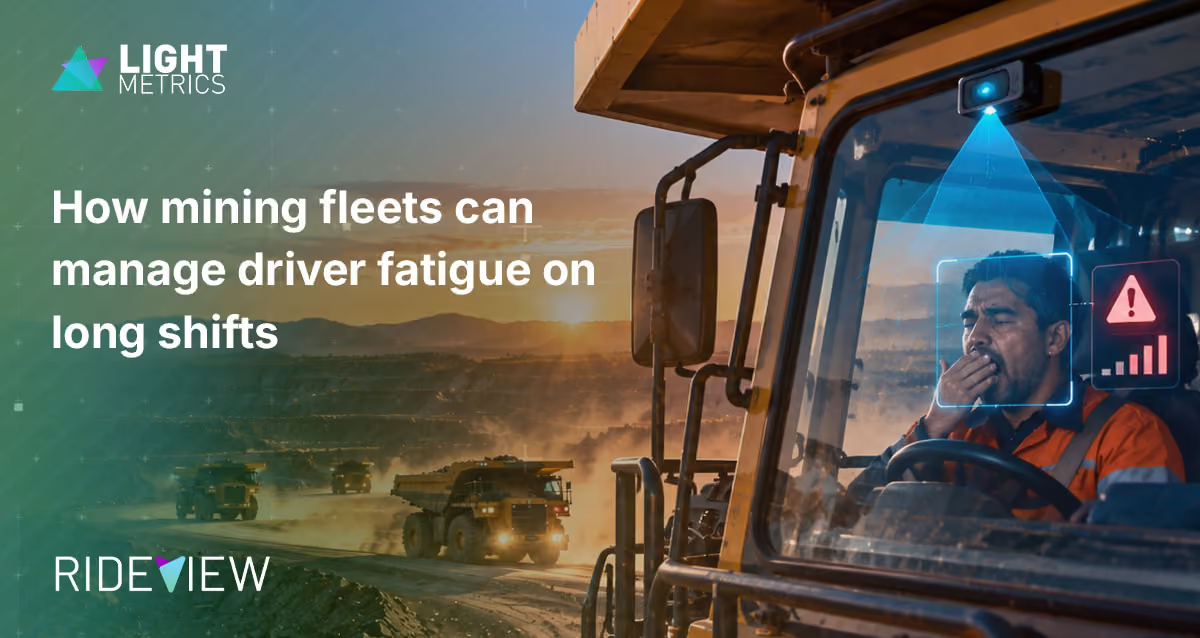
How mining fleets can manage driver fatigue on long shifts
Twelve-hour shifts, night rotations and monotonous haul cycles make fatigue a constant risk. Covers in-cab drowsiness detection and fatigue-focused coaching. Keep it strictly mining-specific since a general fatigue post already exists on the blog.
Share


How mining fleets can manage driver fatigue on long shifts
Fatigue is mining's most persistent vehicle risk because the roster manufactures it. Twelve hour shifts, seven day swings and night rotations collide with human biology, and a widely cited Caterpillar Global Mining study attributes an estimated 65 percent of mining haul truck accidents to operator fatigue. Managing it takes a closed loop that predicts, detects, intervenes, reviews and adjusts, rather than any single technology or policy standing alone.
The haul cycle itself works against alertness. A loaded run, a dump, an empty return and a queue, repeated for twelve hours through the circadian low between two and five in the morning, is close to a laboratory design for microsleeps. Operators rarely feel the lapse coming and almost never report it afterward, partly because nobody remembers a microsleep and partly because admitting tiredness still reads as weakness in plenty of crews. A management approach that depends on self-reporting is managing paperwork rather than fatigue.
Why is fatigue so hard to manage on a mine site?
The inputs sit outside the gate as much as inside it. Sleep before shift depends on camp conditions, commute length, family demands and how well a body adapts to rotating between days and nights, none of which a supervisor can see at pre-start. Two operators on identical rosters arrive with entirely different sleep debts, and the same operator varies day to day. Static countermeasures, a rule here and a poster there, treat everyone as an average that nobody is.
Monotony then hides the evidence. A fatigued operator on a monotonous circuit does not swerve dramatically, they drift a metre, correct late at a junction, and shave the margin nobody measures until the shift where the correction does not come. The precursors are visible to a camera long before they are visible in incident statistics. Sites that measure drowsiness events per shift discover their risk profile was never where the anecdotes pointed.
A closed loop for fatigue management
Effective programs run the same five stage loop continuously, with each stage feeding the next. The strip below shows the loop, and the stages follow in detail.

Predict. Use roster data, shift position and swing patterns to know where fatigue pressure will concentrate before it does. The fourth night shift and the last hours of a long swing are predictably dangerous, and pre-start checks can weight accordingly. Prediction sets expectations, and it never sees the operator who slept badly for other reasons, which is why the loop continues.
Detect. Driver-facing edge AI reads eye closure, head position and yawning in real time, on the device, with no connectivity required in the pit. RideView, our video safety platform, treats drowsiness as a first-class event with the same cloud verification as any other risk, so supervisors see confirmed fatigue rather than every blink. Detection catches the operator prediction missed.
Intervene. The first response is an instant in-cab voice alert, which breaks the microsleep spiral in the only seconds that matter. Repeat events escalate to dispatch under a site protocol, with a defined path to a break, a task rotation or a relief operator. The intervention rules should be written, known and applied evenly, because consistency is what makes operators accept them.
Review. Verified drowsiness events, mapped by hour, zone, crew and roster position, turn fatigue from anecdote into pattern. A cluster at 3 a.m. on the ramp circuit is a finding, and so is a crew that stays clean through the same hours. Review is where the site learns which of its beliefs about fatigue were true.
Adjust. Feed the findings back into the inputs, adjusting break placement, task rotation, roster design and route assignments where the data says pressure peaks. Small changes move real numbers, since fatigue risk concentrates in narrow windows rather than spreading evenly. The loop then starts again with better predictions than last swing.
What the data changes for supervisors
Fatigue conversations stop being accusations and start being facts shared in both directions. A supervisor holding a verified event has something concrete and fair to discuss, an operator with a clean record through night swings holds proof of it, and crews watch the same standard apply to everyone. The cultural shift matters as much as the detection, because a site where flagging fatigue triggers support rather than blame is a site where the data keeps flowing. Programs run this way tend to find operators become their advocates within a swing or two.
Detection is the safety net, rosters are the cause
A camera catches fatigue at the last line of defense, and the causes live upstream in rosters, commutes and sleep. Chronic sleep debt needs roster science, camp and travel policy, and medical screening for conditions like sleep apnea that no schedule change fixes. In-cab detection keeps people alive while those slower levers move, and its data is precisely what justifies moving them. Sites should resist declaring victory when alert counts fall, since the durable win is the roster that stops producing the alerts.
Driver fatigue in mining FAQ
How common is fatigue in mining accidents?
A widely cited Caterpillar Global Mining study attributes an estimated 65 percent of mining haul truck accidents to operator fatigue. The concentration is highest on night shifts and late in long swings. Most fatigue events leave no trace in incident data until detection technology starts counting them.
How do cameras detect operator drowsiness?
Driver-facing AI tracks eye closure duration, blink patterns, head nods and yawning, processed on the device in real time. Confirmed drowsiness triggers an immediate in-cab voice alert, and the event uploads for verification and trending. Detection works offline, which matters in pits without coverage.
What should happen when a fatigue alert fires?
The alert itself handles the moment, and the protocol handles the pattern. A single event means the operator was warned in time, repeat events in a shift should trigger a dispatch check-in with a defined path to a break or relief. Written, evenly applied escalation rules are what keep the program trusted.
Find out when your site is tired
Every mine has a fatigue window, and most sites are guessing where it is. Our video telematics for mining fleets page shows how RideView detects drowsiness on the vehicles you already run. Request a demo at lightmetrics.co.
Latest in fleet safety.

Why Insurance Leaders Are Betting on Video Telematics to Transform Fleet Risk
Why Insurance Leaders Are Betting on Video Telematics to Transform Fleet Risk
Why Insurance Leaders Are Betting on Video Telematics to Transform Fleet Risk

Get in touch with us.
If you want to learn more or want to consider offering RideView to your fleet customers, Please reach out.