
How video evidence shuts down false claims against supply chain fleets
False and exaggerated claims drive up insurance and settlement costs. Covers driver exoneration with HD clips, faster claims resolution and lower total cost of risk.
Share


How video evidence shuts down false claims against supply chain fleets
False and staged claims target supply chain fleets for a simple reason, which is that a commercial truck reads as an insured company with money behind it. Driver exoneration, the use of video and vehicle data to prove a driver was not at fault, shuts these claims down, frequently on the day the footage is reviewed. Without evidence, the same claims get settled to avoid litigation costs, and every settlement teaches the fraud economy that trucks pay.
The problem has grown serious enough for Congress to move. The Staged Accident Fraud Prevention Act, introduced in the House in April 2025 with a Senate companion in July 2026, would make staging a crash with a commercial truck a federal crime carrying up to 20 years in prison. The bill follows cases like the Louisiana scheme in which an attorney admitted paying a co-conspirator to stage 31 tractor-trailer crashes, settling 17 of the resulting claims for about $1.5 million. Organized rings treat unprotected fleets as inventory, and legislation alone will not change the economics of a claim your insurer cannot disprove.
How do false claims against fleets work?
Most schemes exploit the same asymmetry, since a jury or adjuster hearing a truck-versus-car story starts with sympathy for the car, and the fleet must prove a negative without a witness. Some claims are outright staged productions with rehearsed drivers, recruited passengers and a lawyer waiting, while others are opportunistic, turning a tap in traffic into a spinal injury or attaching last year's dent to yesterday's lane change. Insurers often settle marginal claims because defending costs more than paying, and those settlements flow into premiums that flow into freight rates. Everyone in the chain pays for the fraud except the people committing it.
Certain patterns repeat often enough that claims teams treat them as signatures.
• A sudden, unexplained brake check directly in front of a truck with traffic clear ahead.
• A phantom sideswipe reported in a lane the truck never left.
• Damage that predates the alleged incident, presented as fresh.
• Injury claims out of scale with minor or nonexistent contact.
• A witness who appears instantly and supports the other party's account in detail.
Exoneration in practice
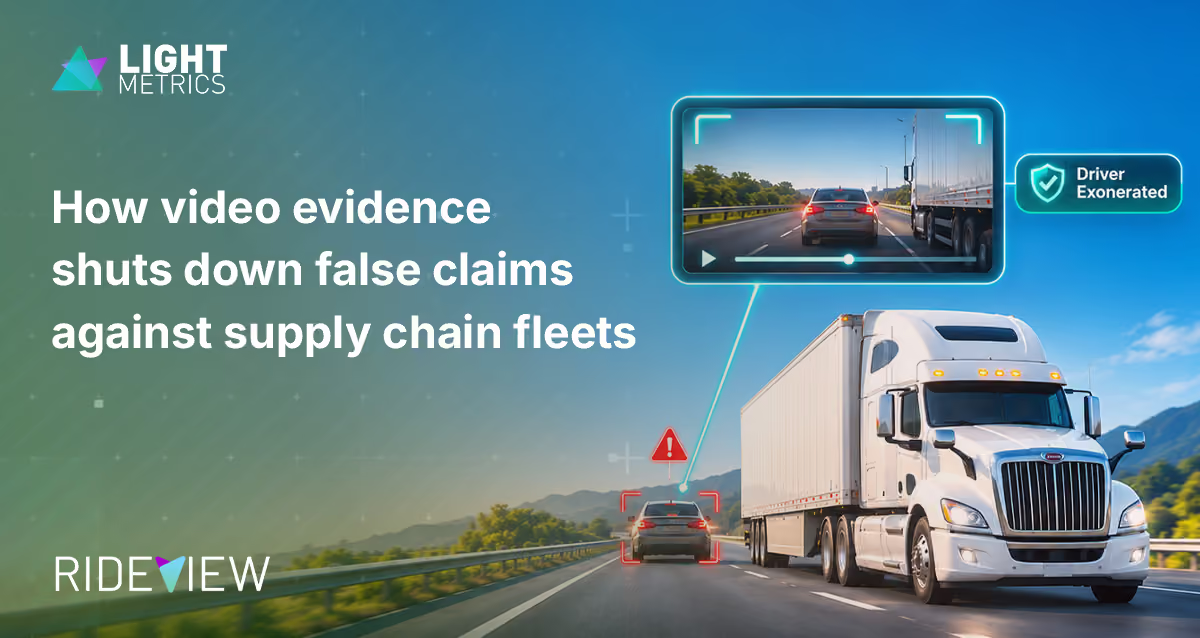
The workflow is short when the evidence exists. An impact or harsh event triggers the camera automatically, the clip uploads with time, location and speed attached, and a claims manager or insurer reviews it within hours of the report. Road-facing footage shows the brake check, the lane position or the absence of any contact at all, and a claim that meets its own footage tends to be withdrawn rather than argued. For claims surfacing days or weeks later, on-demand DVR retrieval pulls the window in question, which is why camera health and retention discipline matter as much as the cameras themselves. RideView, our video safety platform, verifies events in the cloud and keeps every camera monitored, so the clip exists on the day somebody lies about your truck.
The driver is the other party being protected. An accusation of causing a crash follows a professional driver onto their record, their CDL and their sleep, and months of uncertainty do damage no settlement refunds. Fleets running exoneration programs report the same pattern, which is that drivers become the program's strongest advocates once the first colleague is cleared by footage. Protection drivers can see builds the trust every other part of a safety program spends.
The economics compound across the chain
Every fraudulent payout avoided is pure loss prevention, and the effects stack. Claims histories clean of nuisance settlements hold premiums down at renewal, premiums feed the rates shippers pay, and lanes served by protected fleets stay stable instead of absorbing fraud as a cost of doing business. In the current litigation climate, where verdicts against carriers keep climbing, the same footage that defeats a staged claim also documents ordinary care if a legitimate crash ever reaches a courtroom. Shippers and 3PLs increasingly recognize the connection, asking about video programs in carrier vetting because an unprotected carrier's fraud exposure eventually becomes their freight cost.
Evidence discipline decides outcomes
Video only wins when it is available, authentic and complete. Dead cameras discovered on claim day are the classic failure, which makes automated camera health monitoring a claims tool rather than an IT nicety, and retention policies need to hold footage long enough for late-surfacing claims while staying consistent enough to defend. Selective preservation invites spoliation arguments, so keep the policy simple and follow it every time. Train drivers to report suspicious incidents immediately, since the fastest exonerations start with a driver who knew the footage would back them up.
Driver exoneration FAQ
What is driver exoneration?
Driver exoneration is proving through video and vehicle data that a driver was not at fault in a crash or alleged incident. It typically combines road-facing footage, speed and braking data, and GPS position from the moment in question. Exoneration protects the driver's record, the fleet's claims history and the insurer's loss ratio at once.
What should a fleet do right after a suspicious crash?
Preserve everything immediately, starting with the event clip and the surrounding DVR window, and photograph the scene if the driver safely can. Report to the insurer with the footage attached rather than after it, since early evidence shapes how the claim is handled. Instruct drivers to stay factual at the scene and admit nothing they cannot know.
Do insurers reward fleets that run video telematics?
Programs vary, and the dependable reward shows up in outcomes rather than list-price discounts. Claims close faster and cheaper with footage, fraudulent claims collapse instead of settling, and a defensible loss history strengthens every renewal conversation. Some insurers add explicit credits for verified video programs, which is worth asking about directly.
Make your fleet a bad target
Fraud rings choose targets that cannot fight back, and footage changes the category your trucks sit in. Our video telematics for supply chain fleets page shows how RideView puts exoneration-grade evidence behind every vehicle. Request a demo at lightmetrics.co.
Latest in fleet safety.

Why Insurance Leaders Are Betting on Video Telematics to Transform Fleet Risk
Why Insurance Leaders Are Betting on Video Telematics to Transform Fleet Risk
Why Insurance Leaders Are Betting on Video Telematics to Transform Fleet Risk

Get in touch with us.
If you want to learn more or want to consider offering RideView to your fleet customers, Please reach out.