
Choosing video telematics that can handle mining conditions
Dust, vibration, heat and connectivity dead zones. A buyer's guide to hardware-agnostic, edge-processed video that keeps working off-road and offline.
Share


Choosing video telematics that can handle mining conditions
Video telematics for mining is a different purchase from video telematics for a highway fleet, because a mine site destroys equipment that merely meets its spec sheet. Dust coats lenses, corrugated roads shake connectors loose, heat cycles cook electronics, and the pit floor sits outside cell coverage for hours at a time. The right choice comes down to hardware that survives the site, AI that works offline, and a platform that covers every vehicle class from ultra-class haulers to the light vehicles that weave between them.
The cost of choosing wrong is usually silence. A system that quietly stops recording in month three delivers its bad news on the day an investigation needs footage that does not exist, and by then the budget cycle has moved on. Mining buyers should evaluate for the worst week on site rather than the demo in the car park, and the criteria below are built for exactly that.
What do mining conditions do to standard equipment?
Vibration is the patient killer. Haul roads transmit constant low-frequency shake that fatigues mounts, works connectors free and blurs any camera not fixed and rated for it, and the failure arrives gradually enough that nobody notices until footage is needed. Dust attacks the optics from the first shift, hazing lenses and settling into housings, while washdown bays answer with high-pressure water that finds every seal. Heat finishes the job in summer pits where cab and body temperatures run far beyond what consumer electronics tolerate, and cold-climate sites deliver the same stress from the other direction.
Connectivity is the operational gap. Large stretches of most pits have no usable signal, which turns cloud-dependent systems into expensive mirrors for hours at a time. Any system worth installing has to detect, alert and record entirely on the vehicle, then reconcile with the cloud when coverage returns. On-device AI stopped being a nice-to-have the moment the truck left the gate.
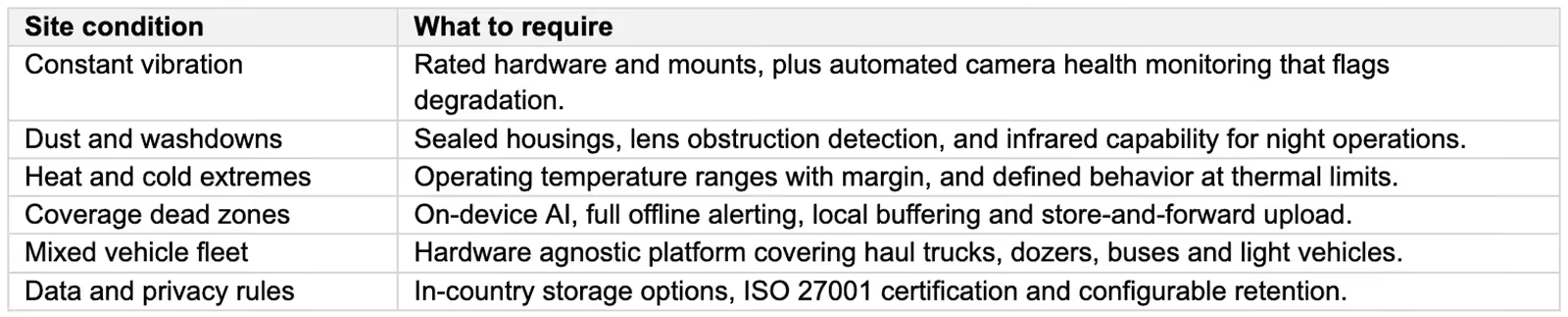
Match the requirement to the condition
The table below turns site conditions into procurement language. Put each row in the RFP and make vendors answer it specifically.
Questions that separate vendors
Shortlists converge quickly once the questions get specific. Put these to every candidate and keep the answers next to the contract.
☐ Where does the AI run, and what still works with zero connectivity for a full shift?
☐ How are false positives handled on dusty, vibrating vehicles, and what verification sits between raw alerts and my supervisors?
☐ How will I know a camera has failed, before the day footage is needed?
☐ How long can events buffer locally, and what happens when the buffer fills?
☐ Which APIs integrate with our fleet management and dispatch systems, and under whose control?
☐ Can site speed zones and private road rules be configured, since public road logic does not apply in the pit?
☐ What does deployment and support look like at a remote site, in practice and in the contract?
Run the pilot where it hurts
A pilot proves nothing unless it runs on the site's hardest conditions. Put cameras on the dustiest circuit, the wettest season and the night shift, across both a hauler and a light vehicle, and hold the trial long enough to cross a maintenance cycle. Measure four things: uptime, verified event accuracy, false positive rate and operator acceptance, and weigh them equally, since a technically perfect system that operators resent will underperform an accepted one every time. Vendors confident in their hardware will welcome the framing, and the other kind of vendor is what the pilot exists to reveal.
Ratings are claims, sites are proof
IP ratings and temperature ranges describe test chambers rather than your pit, and the gap between the two is where budgets go to die. Plan spares and service logistics for remote operations, budget realistically for the connectivity the system needs at the gate and the workshop, and treat camera health monitoring as the core feature it is rather than an add-on. The platform matters as much as the hardware, since cameras are replaceable and a site's worth of event history, integrations and operator trust is not.
Video telematics for mining FAQ
Does video telematics work underground?
Surface operations are the primary environment for vehicle video telematics, and underground deployments carry different infrastructure demands around lighting, dust and network design. Some capabilities transfer where site networks support them. Underground programs should be scoped as their own project with vendors experienced in that setting.
How do systems handle dust on camera lenses?
Good platforms monitor image quality continuously and flag obstruction or degradation automatically, so a hazed lens becomes a work order rather than a surprise. Lens checks belong in pre-start inspections alongside lights and tires. Sealed, site-rated housings slow the problem, and monitoring catches what remains.
Can one platform cover haul trucks and light vehicles?
Yes, when the platform is hardware agnostic and the AI runs on affordable commodity cameras. Light vehicles are the most common coverage gap on mine sites despite sitting in the most dangerous interactions. One platform across the mixed fleet is what makes site-wide risk visible in a single picture.
Buy for your worst week, and prove it in the pit
Write your RFP from the table above, then make the shortlist earn its place on your hardest circuit. Our video telematics for mining fleets page shows how RideView is built for the conditions that break lesser systems. Request a demo at lightmetrics.co.
Latest in fleet safety.
Why Insurance Leaders Are Betting on Video Telematics to Transform Fleet Risk
Why Insurance Leaders Are Betting on Video Telematics to Transform Fleet Risk
Why Insurance Leaders Are Betting on Video Telematics to Transform Fleet Risk
Get in touch with us.
If you want to learn more or want to consider offering RideView to your fleet customers, Please reach out.