
How safety scores help logistics carriers win more freight
Shippers increasingly vet carriers on safety performance before awarding contracts. Covers how CSA scores and video-backed safety data strengthen carrier selection and help carriers win freight.

Share


How safety scores help logistics carriers win more freight
Freight increasingly goes to the carriers with the cleanest safety data. Shippers and brokers screen carrier safety scores, meaning CSA percentiles, DOT safety ratings and crash history, before rates ever enter the conversation, and a May 2026 Supreme Court ruling gave them a strong legal reason to screen harder. Carriers that manage those scores deliberately hold their place in routing guides while competitors quietly fall out of them.
The shift has been building for years and has now become structural. Vetting platforms pull FMCSA data automatically the moment a broker considers a carrier, so an elevated score filters you out before a human ever looks at the load. Nobody calls to explain that a score cost you the freight. The tender simply goes to someone else, and the pattern only becomes visible in a thinner load board and longer gaps between offers.
Which carrier safety scores do shippers and brokers check?
The core dataset is FMCSA's Compliance, Safety, Accountability program, usually shortened to CSA. It scores every carrier across seven categories called BASICs, covering unsafe driving, crash history, hours of service, vehicle maintenance, controlled substances, hazmat compliance and driver fitness, using roadside inspections and crash records from a rolling 24-month window. Results appear as percentiles against carriers of similar size and exposure, and a higher percentile means worse performance. Alongside CSA sits the formal DOT safety rating of satisfactory, conditional or unsatisfactory, which carries particular weight because it reflects a full compliance review.
Very few brokers read the raw data themselves anymore. Carrier vetting platforms monitor these numbers continuously, flag carriers that cross internal thresholds and suspend them from routing guides automatically. Insurance underwriters study the same figures when setting premiums, which means a weak score costs money twice, once in lost freight and again at renewal.
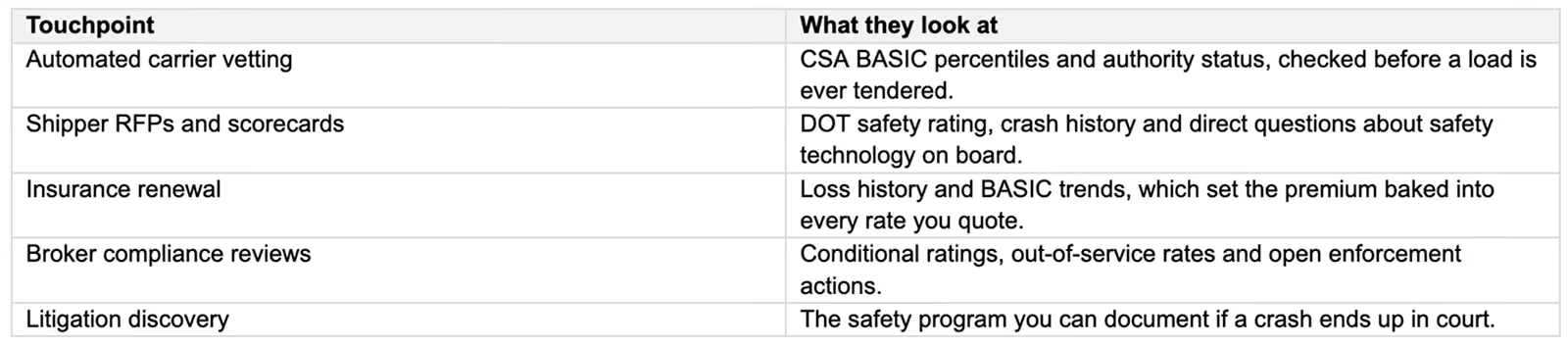
Safety data now touches almost every stage of a freight relationship. The table below maps where your record surfaces and who is looking at it. Each touchpoint is a place where a strong score works for you silently.
Why the bar for carrier vetting just rose
In May 2026 the Supreme Court ruled unanimously in Montgomery v. Caribe Transport II that negligent hiring claims against freight brokers are not blocked by federal preemption. The case involved a broker that had tendered freight to a carrier holding a conditional safety rating, and the ruling means brokers can now face those lawsuits in every state. Brokers responded the only way they can, by tightening carrier vetting and documenting every selection decision. A carrier's safety data has become the evidence a broker will one day show a jury.
For carriers, the commercial consequences are direct. A conditional rating or a spiking BASIC percentile now reads as litigation risk, and brokers are codifying stricter cutoffs so their vetting files hold up in court. Carriers with clean, well-documented safety data become the safe harbor, which is a competitive position rather than a compliance chore.
How video telematics improves carrier safety scores
Scores move when roadside behavior moves. In-cab alerts correct speeding, following too closely and phone use in the moment, which are exactly the behaviors that become violations in the Unsafe Driving BASIC when an inspector is watching. Fleets running RideView, our video safety platform, have cut distracted driving by up to 70 percent and speeding by up to 50 percent. Fewer violations flow into a better percentile as the 24-month window rolls forward, and every clean inspection dilutes what remains.
Video also fixes the score a crash leaves behind. FMCSA expanded its Crash Preventability Determination Program for crashes occurring on or after December 1, 2024, growing the eligible list to 21 crash types and accepting dash cam video as evidence, including any crash where footage demonstrates the sequence of events. A crash judged not preventable is excluded from the SMS Crash Indicator calculation entirely. Road-facing footage is often the difference between carrying someone else's mistake on your score for two years and clearing it in months.
The same program strengthens the sales side. Shipper questionnaires increasingly ask what safety technology runs in your trucks, and a documented video coaching program with trending scores is a credible answer rather than a checkbox. The footage that improves your BASICs also exonerates drivers in claims, which keeps insurance conversations on friendlier terms.
A good score gets you considered, service wins the load
Safety data works as a gate, not the whole game. Among qualified carriers, freight still moves on price, capacity and on-time performance, so a clean record earns the chance to compete rather than the contract itself. Scores also lag behavior, since the 24-month window means today's improvements show up gradually. Smaller carriers should expect volatility too, because a handful of inspections can swing a percentile in either direction.
Consistency ends up mattering more than any single number. One driver's bad quarter can move a small fleet's Unsafe Driving BASIC, so hiring standards, coaching and recognition all feed the same scoreboard. Carriers that treat safety data as a managed asset compound their advantage every month the window rolls.
Carrier safety scores FAQ
What CSA score do brokers consider acceptable?
There is no single published cutoff, since every broker sets its own thresholds and many apply stricter limits than FMCSA's own intervention levels. A conditional safety rating has become close to disqualifying since the 2026 Supreme Court ruling. The strongest position is every BASIC below threshold and percentiles trending downward, with documentation ready when a shipper asks.
Can dash cam footage remove a crash from my CSA record?
Yes, through FMCSA's Crash Preventability Determination Program. For crashes on or after December 1, 2024, carriers can submit video evidence through DataQs across 21 eligible crash types, including any crash where footage shows the sequence of events. A not preventable determination removes the crash from your SMS Crash Indicator calculation.
How long does it take to improve a carrier safety score?
SMS percentiles draw on a rolling 24-month window with recent events weighted more heavily, so improvement is gradual rather than overnight. Fleets that change roadside behavior typically see meaningful percentile movement within six to twelve months. Crash removals through the preventability program can help faster once a determination comes through.
Make your safety data a sales asset
The next RFP your team answers will ask about safety technology, and the next broker who vets you will pull your scores before anyone talks rates. RideView gives carriers video-backed coaching, driver exoneration and preventability evidence inside the telematics platform they already run, and our video telematics for transportation and logistics fleets page shows how carriers put it to work. Request a demo at lightmetrics.co.
Latest in fleet safety.

Why Insurance Leaders Are Betting on Video Telematics to Transform Fleet Risk
Why Insurance Leaders Are Betting on Video Telematics to Transform Fleet Risk
Why Insurance Leaders Are Betting on Video Telematics to Transform Fleet Risk

Get in touch with us.
If you want to learn more or want to consider offering RideView to your fleet customers, Please reach out.